
Bruce Outridge
Artist | Author | Radio & Podcast Producer | Television Host
How Good is Your Company?
You’ve probably ready them in the trade magazines, you know the ones, the ones that report on how good a company is to work for. I’ve read them many times and know of many of the companies that they talk about. Business is hard and hats off to any company that gets a mentioned in those reports, you must be doing something right and it is a long hard battle to reach the top. Many times though the reporting structure is based on a variety of positions and people in the company and information received in ballots and so on. So you can take all of those factors into account before weighing the truth or you can work from your own criteria. Often you will find that the fleets mentioned have different types of operations and are really not competing against anyone but themselves. Now I am not judging the facts or asking for recounts or any such things. I just bring this up to ask you one simple question and the only answer that matters is yours. What do you think of your company as far as a place of employment?
Why did I ask you this? I asked you this to get your thought process going about your career. The only person that can answer that is you and you should be the only person that matters from your career standpoint. So how do you like where you work? First remember this is not a perfect world, and how people rate where they are will be different for everyone. For me a good company to drive for is a place where they give you steady miles with little wait time, good quality customers that understand the importance of a quality carrier, clean well maintained equipment, operational staff that has been in the driver’s seat and understands the frustrations and importance of the position. Finally you want a carrier that cares about their employees and their families. If there was a death in your family and you had to get home from a location 1000 miles away, how would they do that, would they expect you to return home on your own in due time, or would they put you on the first plane back home and take care of the truck later? If you can answer positively to these questions then you probably work for a good carrier and should be happy they treat you well. Every driver should do their own driver evaluation every couple of years to make sure the carrier you work for is meeting the career goals you have set for yourself. This will help keep yourself working towards your own goals and not be swallowed up by day to day operations of a normal truck driver.
About the Author
Bruce Outridge is a business and leadership consultant for the transportation industry.For more information visit his website at www.outridgeenterprises.ca
Increasing Your Driver Net Worth
Frank was new to transportation and the company. Fresh out of school he was eager to learn the ropes and have a successful career. He asked many questions almost to the point of annoyance, but what many didn’t know he was watching to see the successful drivers and learn how they operated. Frank had a reason for this, his work performance had been spotty, he had a habit of always trying to fit in and usually ended up taking in the wrong information. Like the time he was told to take some time off the job to go fishing and have a colleague clock in, everyone was doing it he was told until they all got caught. As the new guy Frank got fired and this seemed to be a trend in his work history. This time would be different however, and he found a few people that showed him the right way to operate was to watch and listen. As he was getting used to the new job he noticed a beautiful truck come through the gates of the yard. As the truck pulled up to the pumps for fuel Frank went over to admire the truck and introduce himself. The two drivers started up a conversation and Frank asked how he got such a beautiful ride. “The company,” replied the driver. “The company bought you a truck like that?” Frank said. “Every two or three years they bring in a few new ones,” said the driver. Frank was beaming, he would love to drive one of these beautiful rigs. “What have you got to do to get one of those?” Frank asked. “Do you have to run long, stay out for days on end or anything like that?” The driver laughed and replied, “That’s what everyone thinks, but the trick is increasing your worth to the company. Make yourself important to have around by operating like a true professional.”
Most drivers don’t think about how they work at a company. They come and go and figure the company will always need drivers not matter what they do. The truth is that a company may need those drivers, but the best thing is for them to want those drivers. That happens by making yourself so important that losing you would hurt their operation. Two things make drivers important to the company, what they know, and how they operate. A driver with experience and knowledge are extremely important to the seamless operation of a trucking company. They improve fleet performance and profit margins. The first item of importance is how a driver operates. A driver that is a safe driver, has good communication skills, a clean and neat appearance help set standards for the company, increase their professionalism to clients, and bring the operation to a place of quality. Those types of drivers are often rewarded by new equipment and incentives therefore increasing their satisfaction level while increasing their net worth to the company. The second item is knowledge, a driver that knows how to operate efficiently, can make good decisions on the road increasing a company’s operation and can move a company into new markets. These drivers are often rewarded with better runs and steady freight. If you want to remain in the top percentage of quality drivers at your company increasing your net worth is one way to do that. The worst that can happen by trying is having a successful transportation career.
About the Author
Bruce Outridge is a business and leadership consultant for the transportation industry with more than 30 years experience. For more information visit www.outridgeenterprises.ca
The Professional Driver Brand
You’re probably wondering why I am talking about brand in an article for truck drivers. When most people think of brand they think of company logos or storefronts, products and services, but very few think of themselves as a brand. It’s like sales, if you ask people if they sell or like sales most will tell you they can’t sell or don’t like to sell. The fact is we all sell ourselves every day. You may be trying to get a new job and your selling yourself, you may be meeting with a client and be selling yourself, or you may be doing your job to the best of your ability and selling yourself to your company. The fact is we all sell ourselves continuously and need to be aware of the things we do and how they affect our careers. In my workshops and communications with business owners I stress the fact that their name is their brand and that logos, products, and other business items are secondary. So what does this have to do with truck drivers?
When I hold workshops for professional drivers I get two types of people in the workshop. One set is very eager to have a successful career and are new to the industry, the other have been around a while and figure their career has already been set. In the workshop my main message is that what you do throughout your career follows you where ever you go. The reason for that is that is your brand. Your name is your brand and if you think of yourself as a little business you will protect that name for all it’s worth. Your name is what people know you by and gives them the first impression as to the type of person you are. We all know how small the transportation industry is and names and facts get around. Some companies won’t care but most decent companies won’t jeopardize their record by hiring people that will tarnish their image or safety record. Your name, brand, and image are all connected which makes you either a liability or an asset, the choice is yours. The same as teenagers we don’t think the things we do earlier in life will affect us later on but we all know or find out later how untrue that is. Things have a way of following us along in our lives from one place to another even if we have forgotten about them. So how do you keep your brand in top shape?
Operate in a professional manner on the job, not matter what the job. As I tell many people in my workshops for newer drivers even if you want to change positions down the road you need keep your career in check early on. Although I know people in this situation, if you want to be the safety person for a company later in your career, having a list of accidents as a driver isn’t going to give you much credibility in that department, if you’re still working in the industry at that point. if you want to be a dispatcher having lousy time management skills won’t take you very far. Everything follows you in your career so keeping your brand clean is the best thing you can do. If your brand has been tarnished up to now then you can still make it right, correct the things that have been going wrong, learn skills and techniques that you may need to take you to the next level. Increasing your brand awareness is the best way to secure your career for the future.
About the Author
Bruce Outridge is a business and leadership consultant with over 30 years experience from driver to owner operator to consultant and is a columnist for many industry blogs and magazines. For more information visit www.outridgeenterprises.ca
What They Don’t Tell You in School About Business
I often speak to youth groups about entrepreneurship and getting started in business. Not because I am as successful as someone like Richard Branson or other famous entrepreneurs, but often because of the business I started and my background. You can understand why when you look at the odds, high school dropout, starting an art business after a career in trucking, and then leaving a successful position at a large company to begin on my own without any kind of a real plan. A real recipe for success right? Now you’re thinking I am about to tell you what I wished I had done right, but that won’t be happening here!

That’s because I wouldn’t change a thing. I feel I didn’t have the information I needed back in school to make the decisions I have had to make today. When I look back at my school days I don’t feel as though I was encouraged to pursue my talents or interests. In fact I found it the opposite, I was discouraged from drawing which I loved, I got in trouble for drawing on note books, and I wasn’t told how the information I was getting would help me later in life. There was no talk of business opportunities. There was no career days until you got to grade 12. I got 59% for an illustration mark in school and I don’t even remember taking the class. It wasn’t until I got into the work world and began a career did I start learning things that I thought would really help me. It was practicing my art on my own that got me to the level I am at today, and it was good instructors after returning to school in my forties that really encouraged me to follow my dreams and gave me the confidence that is required to move forward.
Today I spend much of my time encouraging others and offering information on the way it really is in the world. People can follow their dreams or make their own choices, but they need the right information. There is enabling someone and encouraging with the right information. I am glad to see that we now have career days beginning earlier at school. We need to let people know that there is hope in their lives even if there is a long road ahead for a career in that dream. I happened to fall into my careers and both involved my passions, but there are many that don’t know that is available. Let’s encourage and not enable, let’s give information and set people off into with their own dreams.
About the Author
Bruce Outridge is an artist, author, consultant, and speaker located in Burlington Ontario and author of the books Driven to Drive, Running by the Mile, and How to Start an Artistic Business in 12 Easy Steps. For more information visit www.outridgeenterprises.ca
What’s Your Style?
How important is style in your business? Do you have style? Do you need style? First you have to know what style is? In the art world many artists seek style, it shows independence, it shows uniqueness. Style can set artists apart and give them a leg up in their career above others in the same field. The problem with style is that it has so many components that it can take years to come to the table. For an artist, style can be a the way they use brush strokes, how they compose a picture and much more. What about business and entrepreneurs, how do you get style if you’re not an artist?
Every entrepreneur or business has a style, some wild and some drab. Like an artists style, a business has it’s own style. That style includes the operations, the product or service, the staff, customer service, and the equipment or talent involved. Styles include the type of marketing or networking that you do, how you deal with people, and the integrity of your company or brand. Do you stand behind your product or service? Do you focus on quality or quantity in your product line or service? What are the goals for your company, are you building it to sell, retire, inspire, or pass on to others? All of these decisions determine your style. The problem with style that I have found as an artist is that you can’t push it. It will come out on its own over time and when you look back after ten or twenty years you will see how you have built your business and the road that you traveled down with your business. So how do you start down the road of creating your style?
As mentioned the style will come on its own so don’t try to have a style, just be yourself. Build your business the way you see fit, treat people the way you would  want to be treated, offer the best product or service that you can and you will see your style come to the forefront on its own. If you try to force style and be something you’re not, it will look phoney and your business will come off as fake and untrustworthy. Style is you or the brand of your business and is intertwined with values and integrity of the people or brand. I have found that doing your best will help bring the best brand and style to the forefront for your business. Enjoy your life and you will create a style that you will be proud of for the long run.
About the Author
Bruce Outridge is an artist, author, entrepreneur, and speaker from Southern Ontario. He is the author of a number of business and leadership books for the arts and transportation industry. For more information on Bruce and his work please visit his website at www.outridgeenterprises.ca
Learn About Inspiring Youth TV

Watch Cashing in on Creativity Television

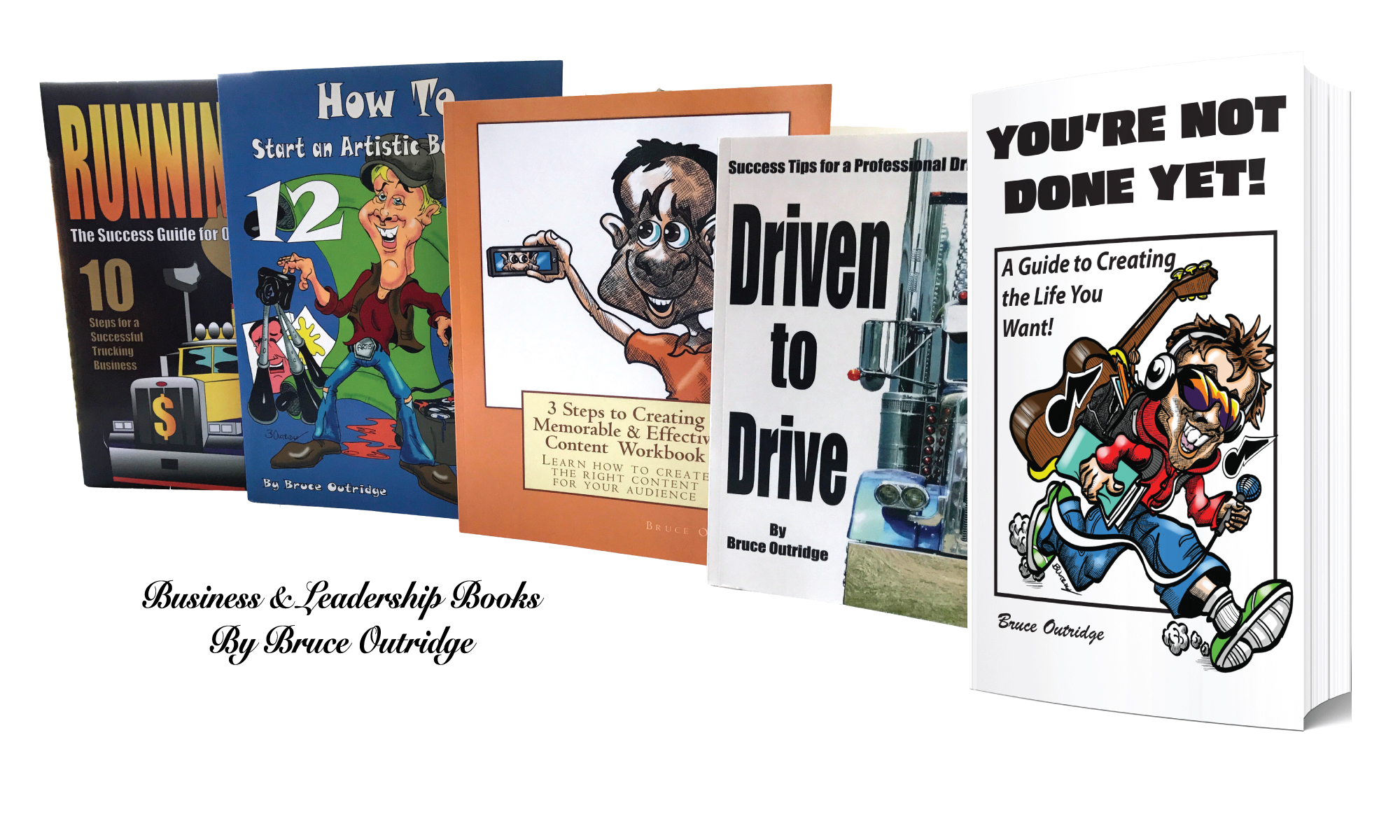
Get Bruce’s Latest Book

Get Bruce’s Books
Book Bruce to Speak to Your Group

The Lead Pedal Podcast with Bruce Outridge

 The Lead Pedal Podcast
- From Trucks to Tunes | Highlights from the Chords & Chrome Show: LP1551
- April 2026 Trucking Events in Ontario | The Lead Pedal Podcast
- What's New for April 2026 | Big Updates from Lead Pedal Podcast, Radio & Media: LP1550
- Old School vs New Rules: What Veteran Drivers Really Think of Today's Trucking Industry: LP1549
- End of the Road: Gord Magill Writing the Truth About Trucking | Lead Pedal Podcast: LP1548
- The State of Trucking: Gord Magill Breaks Down the Industry Today | Lead Pedal Podcast: LP1547
- Shifting Gears Ep14: Raising the Bar-How Red Seal Certification Can Strengthen Canada's Trucking Industry
- Engine Oil Tips Every Owner-Operator Needs | Seasonal Advice with Karin Haumann of Shell Rotella: LP1546
- PTTAC Panel: What Carriers Really Think About Red Seal Certification: LP1545
- PTTAC Insurance Panel: The Insurance Industry's Perspective on Red Seal for Trucking: LP1544
Bruce Outridge Productions





 Bruce Outridge