
Bruce Outridge
Artist | Author | Radio & Podcast Producer | Television Host
Move Forward by Looking Back
Sometimes we all get stuck in a rut especially in business, either sales plateau, the job becomes complacent, or promoting just seems to be stale. I find this happened in our business over the years about every two years, where a big kick start is required to get things going. Often times we see the work coming in regularly and we stop pushing ourselves into new areas, trying new marketing programs, or looking at our business as a whole. The trick for me is to find that excitement that I felt back in the beginning when starting my business. Do you remember those days, when there was no money coming in and the whole business was a fight to get going? I do and I keep those days very close to my heart because it is one of the ways of keeping myself in the zone.
Do you remember your first sale? Do you remember the first time the phone rang for your product or service? I remember it was about ten months into our business at a full time level that we got the call. We had just started that year full time and I had been retraining myself and marketing hard to get things started. We had been getting business but much of it had been because of out calls, networking, and attending various events. Things were going well, but it seemed to be a fight that kept me exhausted and wondering when things would break free. If you’re like me some days you would look at the phone and wonder if it was unplugged. Of course there is always the chance I didn’t pay the bill but at that point I knew it had paid the bill. As this was our first year of business I had signed up for every workshop that year put on by the Business Bureau in my city. These workshops were put on monthly at a small cost of twenty dollars each. I figured if I didn’t get any business and waited for each one to come along I wouldn’t go so I signed up for all of them at once. This trick which I didn’t know at the time enabled me to be eligible to be showcased in their newsletter and office building. As I had attended all these events I was also asked by the organizers to be on a panel for entrepreneurs. It was October and had been a long ten months. Amazingly that same day at about three in the afternoon, the same night I was scheduled to be on the panel, I remember answering the phone to someone I did not know, who found me without me calling them, they phoned to ask about my services. WHOO HOO! Was I pumped! I don’t remember if the client used my services but I was on a high when I attended the panel discussion later that night. I relayed the story to the panel that evening giving the other young entrepreneurs hope that the day the phone rings will come with hard work.
Often I look back on those days, I want that excitement back and I am the only one that can make that happen. If you often are wondering how to take your business to the next level think back to those older days when you had nothing to lose. Get that excitement back and you will begin working on projects to get things moving. Entrepreneurship is built on excitement and dreams for the most part, and that comes from within.
About the Author
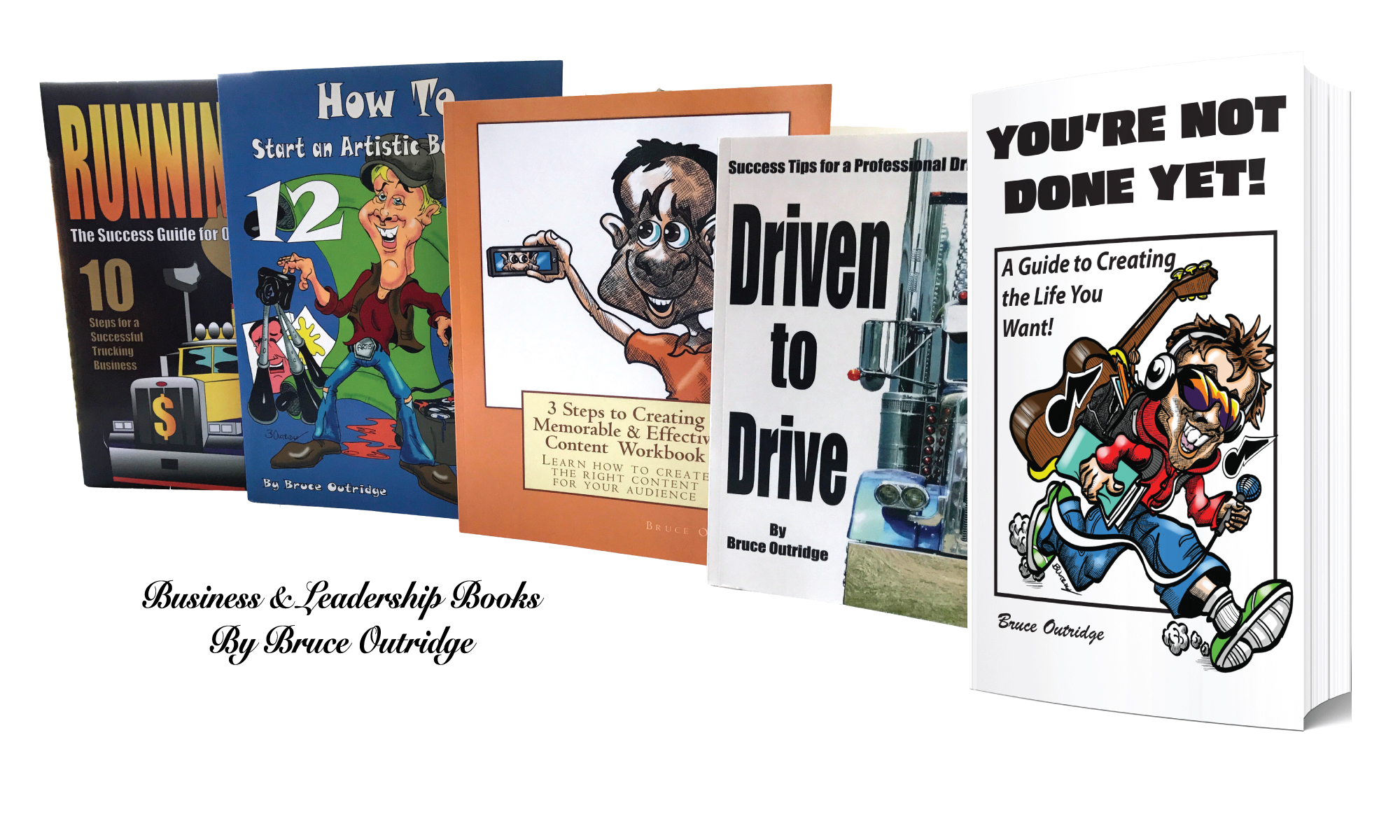
Bruce Outridge is a business and leadership consultant and author of the books Driven to Drive, Running by the Mile, and How to Start an Artistic Business in 12 Easy Steps. For more information on Bruce and his work please visit his website at www.outridgeenterprises.ca
It’s not my fault, I’m just passionate!
Are you passionate about something? Were you passionate early in life and have left those passions behind to follow the hustle and bustle of life? What I found is that you can’t just shut down passions, they either take over you and consume all your time, or you mentally push them to the back of the room and don’t ever look at them again. Passions can come in both good forms and bad and there are some passions that should be stopped and professional help may be required in that area. What I am talking about here however are the positive passions that many of us have and can turn out to great things in later life. 
For me it was drawing at the age of ten and then later driving at the age of sixteen. At ten years old, it was the early seventies and Rock and Roll was in full swing. At that point I didn’t know what music was or how much it would impact my life but I did know I enjoyed what I heard, whatever it was. It would still take a couple of years to kick in but it was starting. Where it came into a central area of my life was when I went into middle school, grades six to eight. With only a record player I found the rock group Kiss. Now you may be thinking that I would go head over heels into music, but I fell into a different area, drawing. What does drawing have to do with music? It has everything to do with it, if the group you are drawing is the group Kiss. My friend and I used to draw them on every piece of paper we could find and if paper wasn’t available there was always the front of a notebook. You may be wondering why I didn’t take any art classes being so much into art, or why my parents didn’t find an art camp for me? In school the art classes were taught out of a book, something I still see being done to this day. The classes were about keeping kids busy with Paper Mâché or the like, so the thought of taking other classes wasn’t an exciting attraction. To be honest I never even suggested it to my parents, it was almost like it was my secret passion that nobody really knew about. It is very hard to run to your parents and say look at my drawing, holding up your notebook when two hours earlier you were given a detention for drawing on the cover. It was a passion I would do in my room, something I didn’t talk much about. What my parents saw were my other hobbies such as hockey, riding my bike, and listening to music with friends. My music I am sure was nothing but annoying so that certainly couldn’t be considered passion to my parents ears. In those days we didn’t understand passion to a point because the hobby was just fun, something I did without being told, something my friends and I did to waste time. I didn’t know back then that drawing a rock group on my notebook was shaping my life and my career for later life. Skip ahead 40 years and today I am a professional illustrator, I still like the rock group kiss, and I still have a deep love for music.
We often think we have to hide our passions, maybe we just don’t realize how much a passion has a hold on us. My belief is you shouldn’t try to push or holdback your passion especially for young people. Let it evolve on its own, some fizzle, some take centre stage, either way you will wake up and realize that your passion played a role in your life. It may just take 40 years!
About the Author
Bruce Outridge is an entrepreneur, artist, author, and speaker. More information can be found on his website at www.outridgeenterprises.ca
Winter Driving Means Keeping a Your Options Open
In Ontario Canada winter driving is probably the time of year when driving conditions can change on a dime. That being said, in many other parts of North America you can find weather conditions that are just as terrifying, just as variable, and just as problematic than other times of the year for weather. No matter which type of weather affects the area of North America that you travel in it is important to know what type of weather can happen in the area and keeping your eye on your options can be the key to making it through your trip in a safe and timely fashion. Experienced professional drivers know that keeping your options open are the key to a successful trip, in fact for many watching and learning about weather patterns can make you money.
My wife and I were on our way back from Florida one year, we had gone on vacation over the Christmas period and were now on our return trip back home. Our normal route would have brought us up the East Coast from Atlanta arriving along the shores of Erie Pennsylvania, through Buffalo and home to Toronto. Our other option was to stick to I-75 travelling up through Detroit, along the 401through Ontario for 4 hours to home. Both routes are common routes for people travelling from the Sunshine State. As we travelled back home I was keeping a keen eye on the weather patterns. That winter had been riddled with severe winter storms as seems common around the Holidays and even our time in Florida had been much colder than expected. Now many people start looking at weather patterns when it arrives close to the area they will be driving through, however I had started watching the weather that was coming across from the West Coast from Southern California, Texas and other locations. Once a weather system got east of Colorado it would warrant my attention and my goal was that it would fizzle out way before it would reach the Midwest or East Coast. We began our journey on the route originally intended and thought we would miss any patterns long before they impacted our route. That wouldn’t be the case however and a system travelling east looked like it would make the last leg of our trip something to be reckoned with. As we were watching the weather system I was thinking about our route, so when suggested to my wife that we stay in West Virginia overnight instead of Ohio the suggestion wasn’t met with high excitement. I had to back up my suggestion with some logic. This storm was going to be a bad one and when I estimated where we would be at the time it hit the road we would have been on we had a good chance of being caught in the worst part. By stopping at a point in our trip where we could make a decision and possibly come up behind the storm made much more sense. Overnight the storm continued on its track and because we made some decisions early we were able to travel to the west side of Lake Erie and had good weather almost all the way home. The other way would have had us on the east side of the Lake where the weather would have been the worst.
Weather patterns travel in regular patterns and watching them travel and estimating your travel route for problems may be just the thing that makes your trip a memorable occasion. Always keep your options open when travelling as Mother Nature has a way of wanting to be everyone’s travel partner.
About the Author
Bruce Outridge is a transportation consultant with over 30 years of experience and author of the books Running by the Mile, and Driven to Drive. More information can be found on his website at www.outridgeenterprises.ca
Slip Seating, is it for you?
Jack had just finished his course at the local truck driving school and was now in the middle of the daunting task of trying to find a job in the industry. He wanted to stay local and also wanted to work at a larger company where he may be able to start a career. Because he was looking for city work he kept hearing of a term called “slip seating” from the company recruiters and didn’t really know what they meant when they said that. On a recent visit back to the school to collect some paperwork Jack decided to ask his old instructor what the recruiters meant  by the term “slip seating” on interviews. Jack’s old instructor was very experienced, he had been driving for almost 30 years, he had a nice temperament, and was passionate about the industry.
Jack said to his instructor Fred, “Fred I have been hearing about this term slip seating on interviews and I don’t really know what it means, what is it?” Fred piped up, “Slip seating is a term referred to sharing the same piece of equipment by several people. Many companies do this if their operations require trucks and equipment to operate around the clock, and of course a person can’t work around the clock. I am not crazy about that type of operation, but it can be very lucrative for those that don’t mind sharing equipment.” Jack thought about what Fred had said, ” I don’t mind that because I am hoping to work around the city, are there any problems I should look out for?” Fred gave a small frown and then replied,”I personally don’t like that type of environment because I am very particular about my equipment, but that is just me. What I would look out for is making sure if you do go into that environment you know who you are working with. It is much like team driving, you need to work with that person, have similar cleaning habits, and have the same respect for maintenance and so on. It is not something to be taken lightly. If you don’t share the same cleaning ethic one person may end up doing all the cleaning. If the truck is always in need of repair on your shift you may find that your productivity is going down. If the program is used for highway units be very weary of the sleeping quarters in the sleeper, by bringing in your own sleeping requirements in sheets, sleeping bags, and other needs.” Jack thought for a moment and then said, “So are you suggesting I stay away from slip seat operations?” “No if that type of work suits you and it is a good company, go for it! I am just suggesting when you meet with company recruiters you ask questions in regard to guidelines for equipment and cleanliness in those situations. It may be a great company but if there is no teamwork between the people sharing equipment it can be very hard to keep that going for the long term.” Jack thanked Fred for his help and went off in the distance, trying to decide if that is the program for him.
Many companies operate a “slip seat” type of operation and many of those companies are very lucrative to work for. It is important however to make sure you are comfortable with the other person and each person does their part to make sure the equipment is kept clean and well maintained.
About the Author
Bruce Outridge is a transportation consultant with over 30 years of experience. He is the author of Books Driven to Drive and Running by the Mile. For more information and other books and more about Bruce please visit his website at www.outridgeenterprises.ca
Selective Attitude
Fred was training a new driver, like many new drivers coming into the industry this new driver was eager to get started and making money. Jack, the new driver had a bit of an attitude, after all he was not a blank canvas, his Grandfather had driven a truck, his Uncle had tractors on his farm that he had driven many times on family vacations, so he didn’t think he needed all this training hubbub. In fact the only reason he was there was because a career counsellor had signed him up due to a lack of money on his part. Jack figured he could have gotten a job on his own, but the career counsellor convinced him he needed training to get a good job. Jack felt he was pushed into the training and his attitude was showing just that.
Fred was in the last week of training with Jack. He was fine with the skills of Jack but his attitude had been hard to overcome. Jack seemed to be fighting every turn of the training and after five weeks both parties were starting to feel very drained. Fred felt Jack would be a good driver if he would just listen and treat others with some respect. Like many other people that come from a family of older drivers Jack had learned the stories of the old days, some of the way drivers would fight with Dispatchers, how they had to chase load brokers for loads and so on. Those days have changed, but Fred noticed that many new drivers feel they know the industry because of those stories. Fred often wondered why many new people fall into this trap and has found it is from trying to fit in and show they have experience. What Fred has actually found out is that it shows the the inexperience even more because those days have changed and the industry is trying hard to change to the new standards for the industry. He often wished that if the new driver would just keep an open mind and listen to the things that are being taught to them they would be much better off.
One of the areas that Fred was having trouble getting through to Jack was in the time management department. Jack just did not move fast and he had the attitude of he wasn’t doing this or that, or he’ll get there when he gets there. That is all the old days coming out,but it was really holding back his training. Fred was now conducting the final assessment on Jack. Jack had the skills, but Fred was nervous about cutting him loose with the attitude still not in check. As he marked off his check list the evaluation came to and end, the two sat in the truck talking about what went right and what went wrong during the evaluation. Most of the items checked off well with the exception of the attitude which Fred had not checked off as of yet. Fred sat in the truck and tried once more to explain to Jack that his attitude will make or break his career in the future. It was the key to making money, it was the key to being hired by good companies, and it was the key to a long satisfying career. If he couldn’t get that under check it would make for a troubled future. Jack sat for a minute talking about what he had been told, he thought, and promised he would do his best to work on that for the future. However only time will tell.
Driving skills are only one part of the equation when beginning a career in the transportation industry. More often than not are the soft skills that give you a good solid career and those should be worked on indefinitely.
About the Author
Bruce Outridge is a transportation consultant with 30 a Years of experience and author of the books Driven to Drive, and Running by the Mile. To learn more or to purchase books please visit his website at www.outridgeenterprises.ca
Learn About Inspiring Youth TV

Watch Cashing in on Creativity Television

Get Bruce’s Latest Book

Get Bruce’s Books
Book Bruce to Speak to Your Group
The Lead Pedal Podcast with Bruce Outridge

 The Lead Pedal Podcast
- From Trucks to Tunes | Highlights from the Chords & Chrome Show: LP1551
- April 2026 Trucking Events in Ontario | The Lead Pedal Podcast
- What's New for April 2026 | Big Updates from Lead Pedal Podcast, Radio & Media: LP1550
- Old School vs New Rules: What Veteran Drivers Really Think of Today's Trucking Industry: LP1549
- End of the Road: Gord Magill Writing the Truth About Trucking | Lead Pedal Podcast: LP1548
- The State of Trucking: Gord Magill Breaks Down the Industry Today | Lead Pedal Podcast: LP1547
- Shifting Gears Ep14: Raising the Bar-How Red Seal Certification Can Strengthen Canada's Trucking Industry
- Engine Oil Tips Every Owner-Operator Needs | Seasonal Advice with Karin Haumann of Shell Rotella: LP1546
- PTTAC Panel: What Carriers Really Think About Red Seal Certification: LP1545
- PTTAC Insurance Panel: The Insurance Industry's Perspective on Red Seal for Trucking: LP1544
Bruce Outridge Productions




 Bruce Outridge